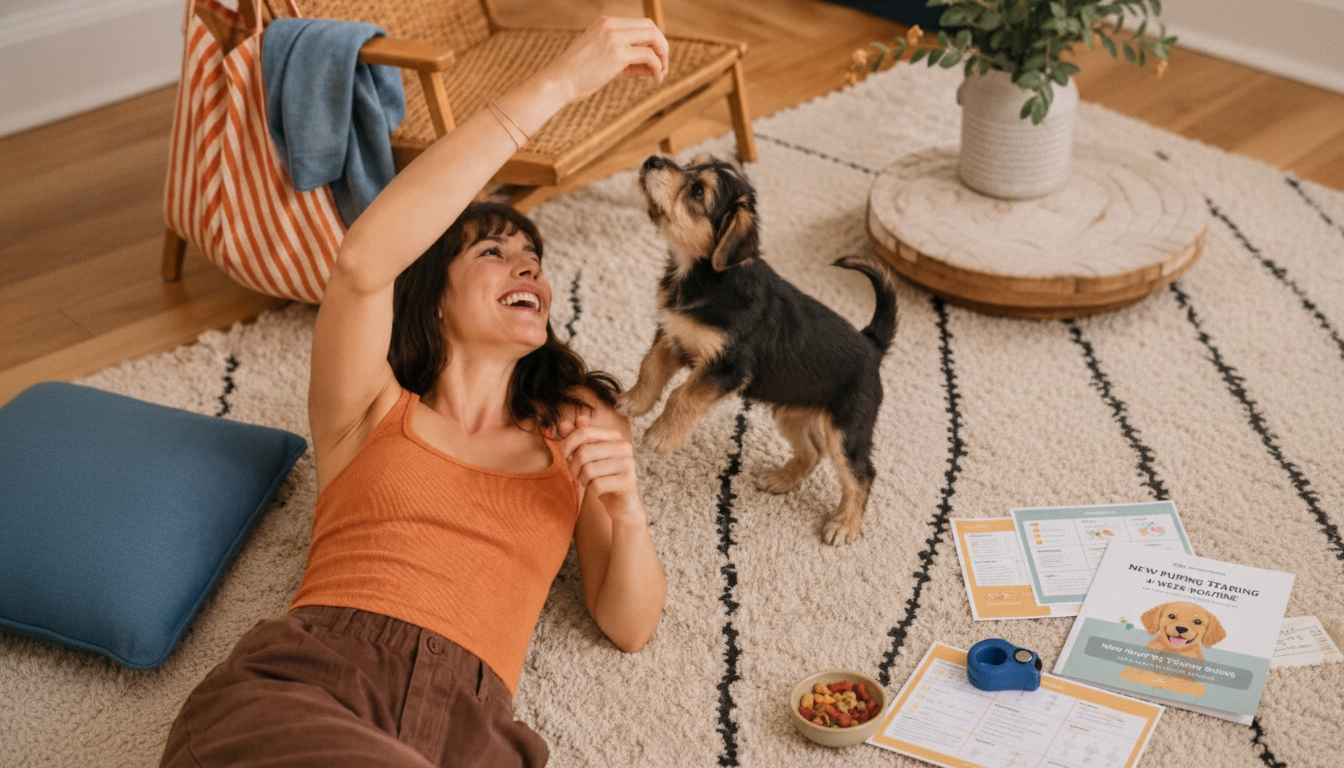
A new puppy learns fastest when days feel predictable and rewards are clear. This starter guide approach organizes house-training, crate comfort, basic cues, bite inhibition, and early socialization into a simple 4-week routine you can follow, print, and repeat—so progress feels measurable instead of chaotic.
What to Set Up Before Training Starts (Day 0 Checklist)
- Pick one potty spot outdoors and use the same door and path each time to build a reliable habit loop.
- Choose a reward system: tiny treats, kibble, toy play, or praise—use what your puppy works for most in that moment.
- Create a safe confinement plan (crate + pen or gated area) to prevent rehearsal of unwanted behaviors when you can’t supervise.
- Establish a calm schedule for sleep, meals, potty breaks, play, and short training sessions (3–5 minutes).
- Decide household rules now (furniture access, begging, jumping) so boundaries stay consistent across everyone in the home.
The 4-Week Training Flow: What Changes Each Week
The goal isn’t perfection by Day 28—it’s a calmer puppy with clearer communication, fewer accidents, and a routine your household can keep up with.
4-Week Starter Plan at a Glance
| Week |
Primary focus |
Daily non-negotiables |
Milestone to aim for |
| 1 |
Routine + bonding |
Potty after sleep/food/play; name game; gentle handling |
Fewer indoor accidents; puppy follows you briefly |
| 2 |
Basics + crate comfort |
Crate meals; 2–3 mini training sessions; short leash walks |
Puppy can settle briefly in crate/pen |
| 3 |
Impulse control |
“Leave it”; structured play; calm greetings practice |
Puppy offers sit for attention sometimes |
| 4 |
Real-life practice |
New environments; longer calm settle; reduce constant prompting |
Cues work in 2–3 locations with low distractions |
- Week 1: Build trust and predictability—potty timing, name recognition, luring into positions, and gentle handling.
- Week 2: Add structure—short crate sessions, leash comfort, “sit,” “down,” and a simple release word.
- Week 3: Improve reliability—practice cues with mild distractions, add “leave it,” and start polite greetings.
- Week 4: Generalize skills—practice in new rooms/locations, increase duration (seconds, not minutes), and strengthen calm settling.
House-Training: A Simple System That Prevents Accidents
- Timing rules: take your puppy out after waking, after eating/drinking, after play, after training, and at least every 1–2 hours early on.
- Supervision rule: if eyes can’t be on the puppy, use the crate/pen—freedom is earned by clean days, not by age.
- Reward rule: treat within 1–2 seconds after potty happens outside and pair it with a consistent phrase (example: “Go potty”).
- Clean-up rule: use an enzymatic cleaner indoors to remove scent cues that can invite repeat accidents.
- Night plan: last potty trip right before bed; keep nighttime outings quiet and boring (no play, no chatting).
For step-by-step housetraining basics, the ASPCA overview is a helpful companion to a consistent routine: ASPCA: Housetraining Your Dog or Puppy.
Crate and Alone-Time Training Without Panic
- Make the crate predict good things: feed meals inside, scatter treats, and offer a safe chew.
- Start with seconds, not minutes; increase duration only when the puppy is relaxed (soft body, quiet, able to settle).
- Close the door while you stay nearby before you add brief step-aways; return calmly before the puppy escalates.
- Avoid using the crate for punishment; it should signal safety and rest, not isolation after “bad” moments.
- Balance confinement with enrichment (sniffing, gentle play, training games) so alone-time practice doesn’t feel like deprivation.
Beginner Commands That Pay Off Fast (and How to Teach Them)
- Name response: say the name once, reward eye contact; sprinkle 5–10 mini “name games” across the day.
- Sit/Down: lure with a treat, mark the instant the position happens, then reward; add the cue word after the motion is predictable.
- Come (recall): practice indoors first; reward heavily and then release back to play so “come” doesn’t always end fun.
- Leave it: start with a closed-hand treat; reward for backing off; progress to items on the floor with leash control.
- Settle on a mat: reward calm body language (lying down, soft eyes, a sigh) to build an off-switch you can use in real life.
If you’d like a general refresher on early training foundations, the AKC’s overview is a solid reference point: American Kennel Club: Puppy Training Basics.
Socialization: Quality Exposure Without Overwhelming the Puppy
- Aim for calm, positive exposures to people, surfaces, sounds, and gentle dogs—not chaotic meet-and-greets.
- Watch body language: loose body, soft mouth, and curiosity are good; freezing, tucked tail, or avoidance means create distance.
- Pair new things with treats at a safe distance; let the puppy choose to approach rather than being pushed forward.
- Prioritize safe health practices: follow your veterinarian’s guidance on where and how to socialize before vaccines are complete.
- Keep sessions short and end on a win before your puppy becomes tired or stressed.
For health-conscious, evidence-based guidance, review the AVSAB Position Statement on Puppy Socialization.
Common Beginner Mistakes (and the Quick Fix)
Printable Plan Option: What’s Inside the New Puppy Training Starter Guide
Recommended printables (in stock)
FAQ
How do I stop my puppy from peeing and pooping in the house?
Use a prevention-first routine: frequent scheduled potty trips (after sleep/food/play), close supervision or confinement when not watched, immediate rewards for outdoor potty, and enzymatic cleaning for accidents. Track timing for a few days so you can tighten intervals, then expand freedom only after several clean days.
Recommended for you








Leave a comment